












Automatic Emergency Braking
What Is Automatic Emergency Braking and How Does It Work?
Automatic emergency braking, often called AEB, is a driver-assistance safety feature designed to help reduce the risk or severity of certain collisions by automatically applying the brakes when the system detects an imminent crash.
The system can monitor the road ahead, warn the driver of a potential collision and, in some situations, apply braking if the driver does not react quickly enough.
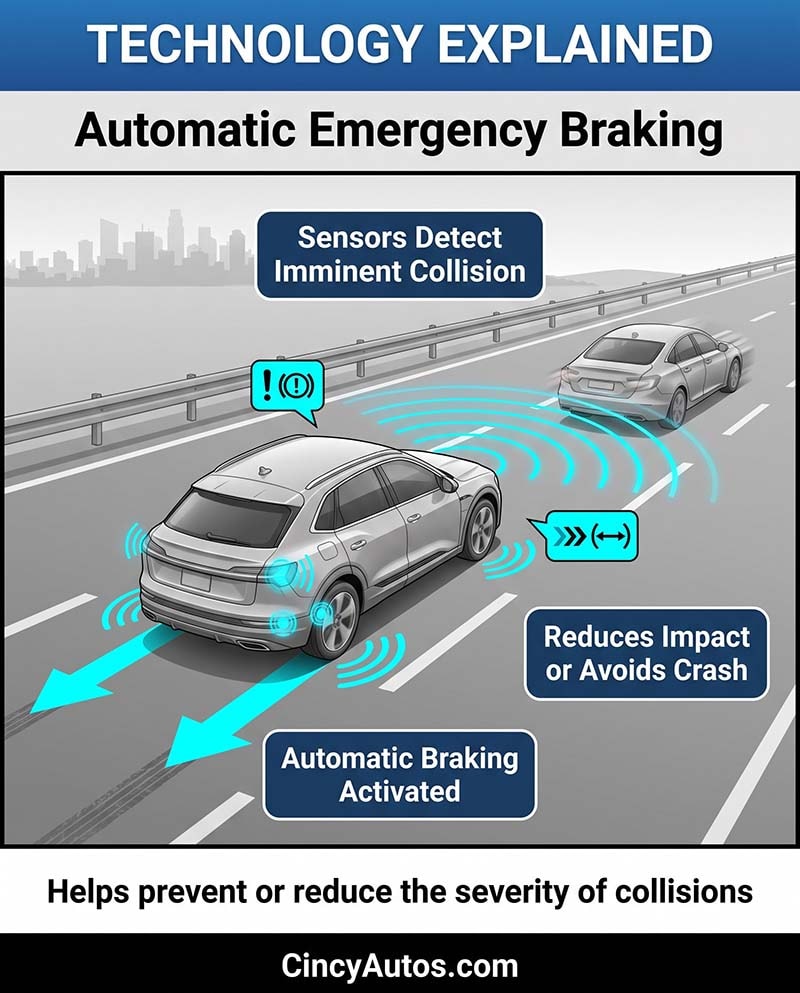
How Does Automatic Emergency Braking Work?
Automatic emergency braking typically uses cameras, radar or other sensors to monitor traffic and obstacles in front of the vehicle.
If the system detects that the vehicle is approaching another vehicle or obstacle too quickly, it may first provide a visual or audible warning to the driver.
If the driver does not respond in time, the system may automatically apply the brakes to help avoid the collision or reduce its severity.
Automatic Emergency Braking vs. Forward Collision Warning
Forward collision warning and automatic emergency braking are related technologies, but they do different things.
Forward collision warning is designed to alert the driver when the system detects a potential collision ahead. Automatic emergency braking can go a step further by applying the brakes if the driver does not respond quickly enough.
Many vehicles combine both technologies as part of the same driver-assistance system.
Can Automatic Emergency Braking Stop the Car Completely?
Some automatic emergency braking systems are capable of bringing a vehicle to a complete stop in certain situations, while others are designed primarily to reduce vehicle speed before a collision.
The system's ability to stop the vehicle can depend on factors such as speed, road conditions, distance to the object ahead and the specific technology used by the manufacturer.
Can Automatic Emergency Braking Detect Pedestrians and Cyclists?
Some newer automatic emergency braking systems are designed to detect more than just vehicles. Depending on the vehicle and system, they may also be able to recognize pedestrians, cyclists or other road users.
Detection capabilities vary widely by manufacturer, model year and driving conditions, so drivers should never assume the system will recognize every potential hazard.
Is Automatic Emergency Braking Worth Having?
Automatic emergency braking can provide an additional layer of protection when a potential collision develops faster than a driver can react.
It can be especially useful in heavy traffic, sudden stop situations and everyday driving where distractions or unexpected events can occur.
AEB is designed to assist the driver, not replace attentive driving or proper following distance.
What Should You Look for When Buying a Used Car With Automatic Emergency Braking?
Automatic emergency braking has been available on many vehicles for years, but availability and capability can vary by model year, trim level and option package.
When shopping for a used vehicle, review the listed safety equipment carefully and ask the dealership to confirm that AEB is included on the specific vehicle you're considering.
It is also worth checking whether the system includes additional features such as pedestrian detection, forward collision warning or other driver-assistance technologies.
Frequently Asked Questions About Automatic Emergency Braking
Does automatic emergency braking work at all speeds?
Not always. Operating speed ranges vary by vehicle and system. Some systems are designed mainly for lower-speed situations, while others can operate at highway speeds.
Is AEB the same as anti-lock brakes?
No. Anti-lock brakes help prevent the wheels from locking during hard braking. Automatic emergency braking is a driver-assistance feature that can apply the brakes when it detects a possible collision.
Can weather affect automatic emergency braking?
Yes. Heavy rain, snow, fog, ice, dirt or other conditions that interfere with cameras or sensors may reduce system performance.
Can automatic emergency braking prevent every crash?
No. Automatic emergency braking is designed to help in certain situations, but it cannot prevent every collision. Drivers remain responsible for controlling the vehicle and reacting to road conditions.
Can used cars have automatic emergency braking?
Yes. AEB can be found on many used cars, trucks and SUVs, although its availability and capabilities depend on the vehicle's model year, trim level and equipment.
Explore More Vehicle Technology
Automatic emergency braking is one of many driver-assistance technologies available on today's vehicles. Explore more CincyAutos Technology Explained guides to learn how other popular safety and convenience features work.
Technology Explained | Adaptive Cruise Control | Blind Spot Monitoring | Lane Centering
Find the Right Vehicle and Technology for You
Explore vehicles available through CincyAutos and our Cincinnati-area dealerships. Compare new, Certified Pre-Owned and pre-owned vehicles to find the features and technology that matter most to you.