












Blind Spot Monitoring
What Is Blind Spot Monitoring and How Does It Work?
Blind spot monitoring is a driver-assistance feature designed to help alert you when another vehicle is traveling in an area beside or slightly behind your vehicle that may be difficult to see in your mirrors.
By monitoring these areas while you drive, the system can provide an extra warning when another vehicle may be in your blind spot, especially when you're preparing to change lanes.
How Does Blind Spot Monitoring Work?
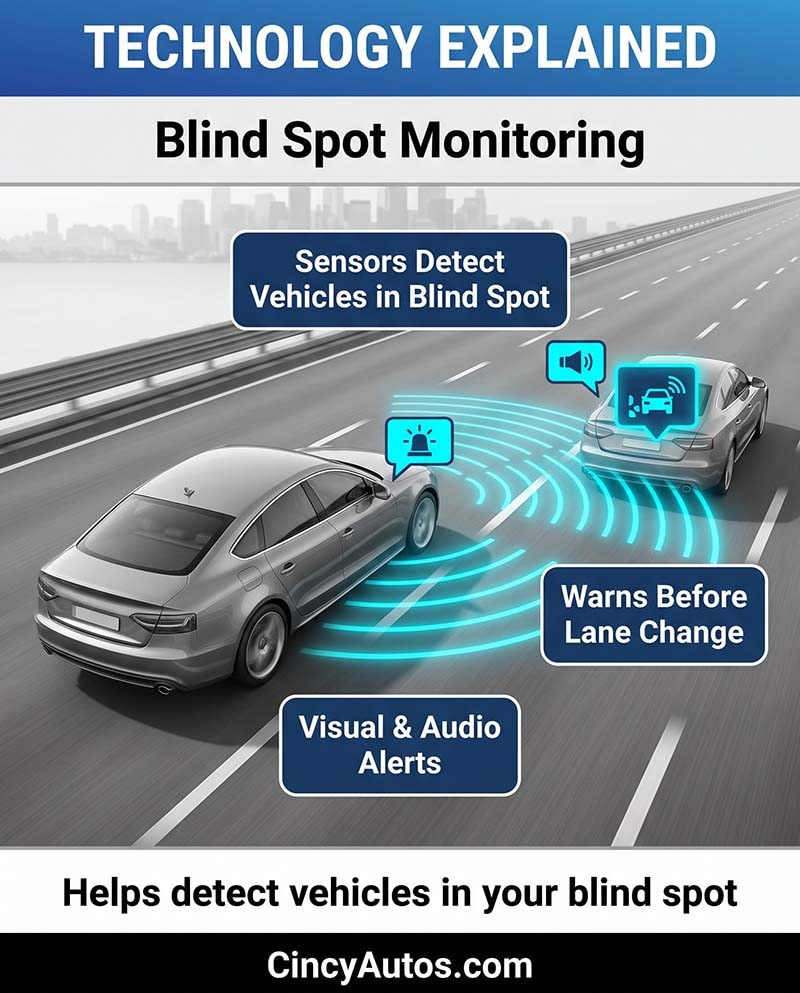
Blind spot monitoring typically uses radar sensors, cameras or other technology to monitor areas alongside and behind the vehicle while you're driving.
When the system detects another vehicle in a monitored blind-spot area, it commonly displays a warning light in or near the corresponding side mirror.
Depending on the vehicle, activating the turn signal while another vehicle is detected may trigger an additional visual, audible or other warning.
What Does the Blind Spot Warning Light Mean?
On many vehicles, the blind spot monitoring warning appears as a small illuminated symbol in or near one of the outside mirrors. If the left-side warning illuminates, the system has typically detected a vehicle in the monitored area on your left. The same applies to the right-side warning.
The exact symbol, location and type of warning vary by manufacturer. Blind spot monitoring is an additional aid and does not replace checking your mirrors, using your turn signals and looking for surrounding traffic before changing lanes.
Blind Spot Monitoring vs. Lane-Change Assist
Blind spot monitoring and lane-change assist are closely related technologies, and manufacturers don't always use the terms in exactly the same way.
Blind spot monitoring generally watches areas beside and behind the vehicle and warns the driver when another vehicle is detected. Some lane-change assist systems monitor a larger area or can provide additional warnings when the driver signals a lane change.
Because capabilities vary by manufacturer, model and model year, it's important to understand how the system works on the specific vehicle you're considering.
Is Blind Spot Monitoring the Same as Rear Cross-Traffic Alert?
No. Although the two technologies are often offered together, they are designed for different driving situations.
Blind spot monitoring primarily helps detect vehicles alongside or slightly behind you while driving. Rear cross-traffic alert is generally designed to warn you about vehicles approaching from either side while you're backing out of a parking space or driveway.
Some vehicles can provide only a warning, while others may offer additional braking assistance depending on the system.
Is Blind Spot Monitoring Worth Having?
Blind spot monitoring can be a useful feature for many drivers because it provides additional awareness of traffic traveling beside the vehicle, particularly during lane changes.
It can be especially helpful when driving on multi-lane highways or in vehicles where rearward visibility is limited.
Like other driver-assistance features, blind spot monitoring is intended to assist the driver rather than replace normal mirror checks and attentive driving.
What Should You Look for When Buying a Used Car With Blind Spot Monitoring?
Blind spot monitoring has been available on many vehicles for years, so you don't necessarily have to buy a new vehicle to get the feature.
Availability can vary by model year, trim level and option package, even among otherwise similar vehicles. Check the equipment listed for the specific used vehicle you're considering and ask the dealership to confirm important features.
It's also worth checking whether the vehicle pairs blind spot monitoring with related technologies such as rear cross-traffic alert.
Frequently Asked Questions About Blind Spot Monitoring
Does blind spot monitoring work at all speeds?
Not always. Operating speeds and conditions vary by vehicle and manufacturer. Some systems may become active only after the vehicle reaches a certain speed.
Where are blind spot monitoring sensors located?
Many systems use radar sensors located near the rear corners of the vehicle, although sensor type and placement vary by vehicle.
Can blind spot monitoring detect motorcycles?
Some systems may detect motorcycles and other vehicles, but detection capabilities and limitations vary. Drivers should never rely solely on the system before changing lanes.
Can blind spot monitoring stop working?
Yes. Dirt, snow, ice, damage or other conditions affecting the sensors may temporarily limit the system. A warning message may appear if the vehicle detects a problem.
Can used cars have blind spot monitoring?
Yes. Blind spot monitoring is available on many used cars, trucks and SUVs, although availability depends on the model, trim level, options and model year.
Explore More Vehicle Technology
Blind spot monitoring is just one of many driver-assistance technologies available on today's vehicles. Explore more CincyAutos Technology Explained guides to learn how other popular safety and convenience features work.
Technology Explained | Adaptive Cruise Control | Automatic Emergency Braking | Lane Centering
Find the Right Vehicle and Technology for You
Explore vehicles available through CincyAutos and our Cincinnati-area dealerships. Compare new, Certified Pre-Owned and pre-owned vehicles to find the features and technology that matter most to you.